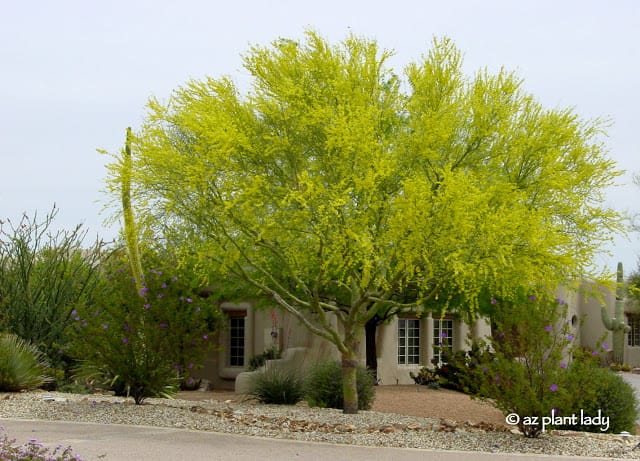
Iconic Desert Tree, The Palo Verde
Iconic tree, Blue Palo Verde (Parkinsonia florida)
When people think of the Sonoran desert, hillsides studded with saguaro cactus and cholla often come to mind. But interspersed between the cactus, you will find the palo verde, an iconic tree with their beautiful green trunks and branches.
An Iconic Desert Tree; The Palo Verde
The word “Palo Verde” means “green stick” in Spanish, referring to their green trunk, which is a survival mechanism in response to drought.
Palo verde trees are “drought deciduous,” which means that they will drop their leaves in response to a drought situation. Their green trunks and branches can carry on photosynthesis, even in the absence of leaves.
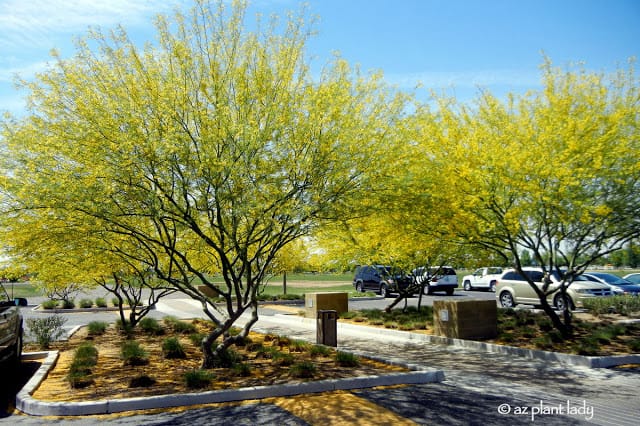
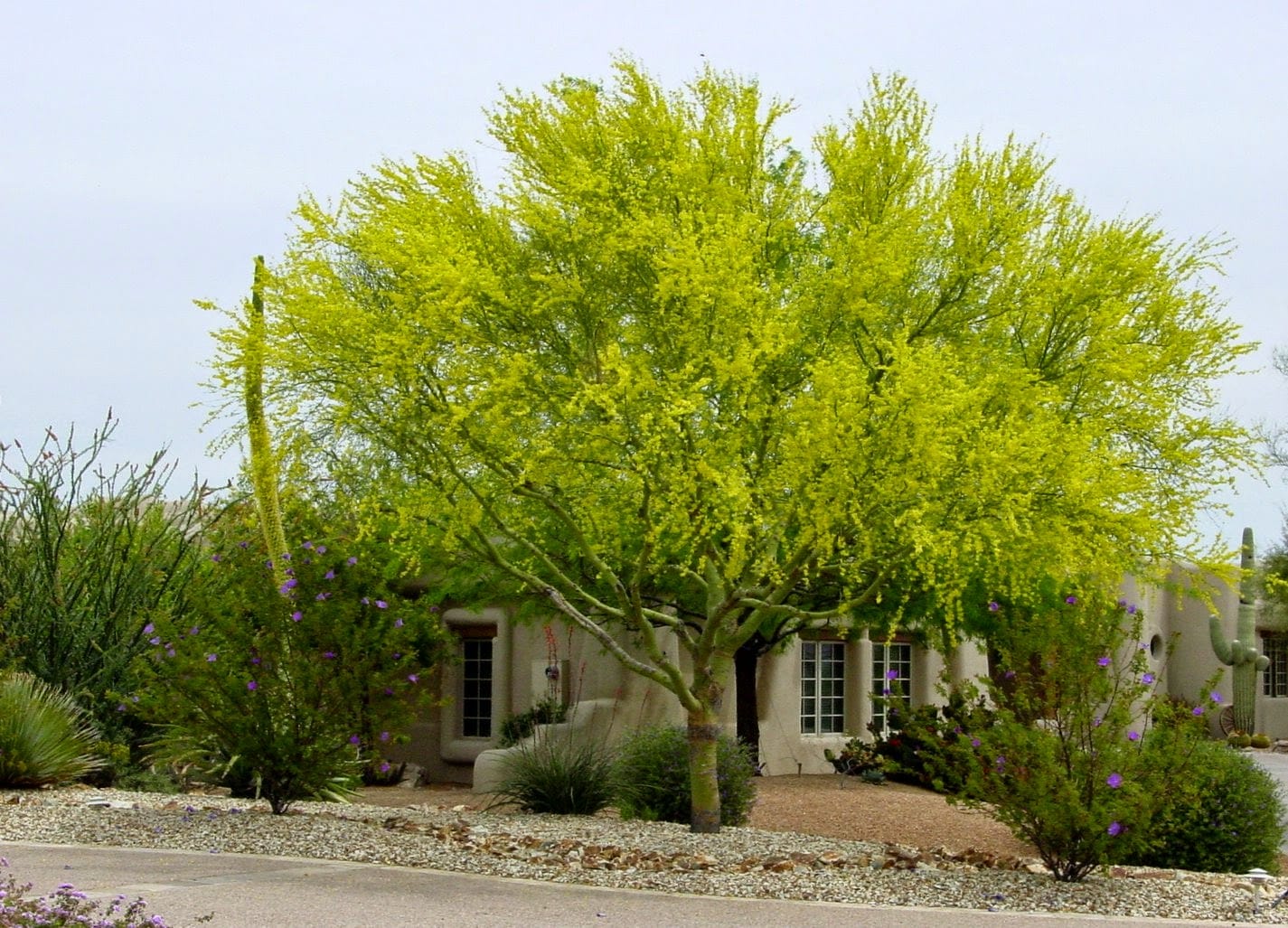
‘Desert Museum’ Palo Verde (Parkinsonia hybrid ‘Desert Museum’)
Palo Verde Trees Are Nurse Plants to Saguaro Cacti
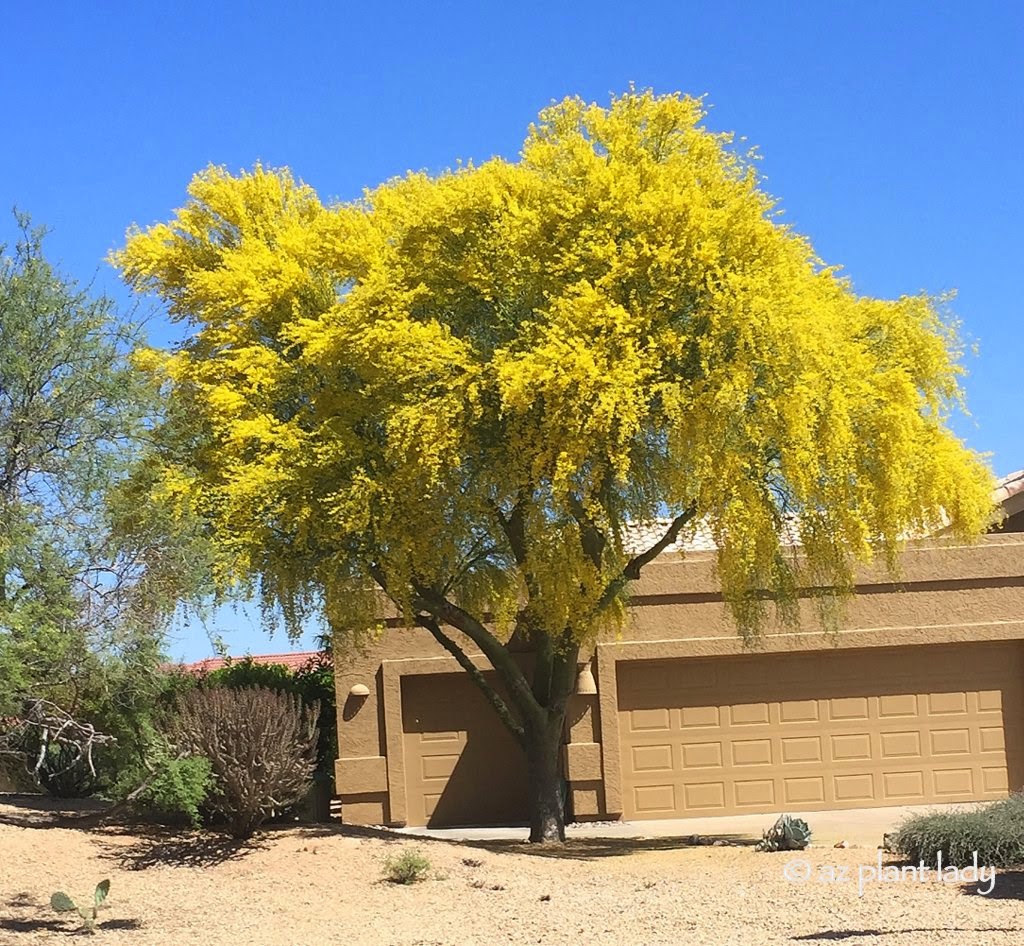
Palo verde trees act as a “nurse plant” to young saguaro cacti by protecting them from the cold in the winter and from the intense sun in the summer. Beautiful, yellow flowers are the product in the spring.
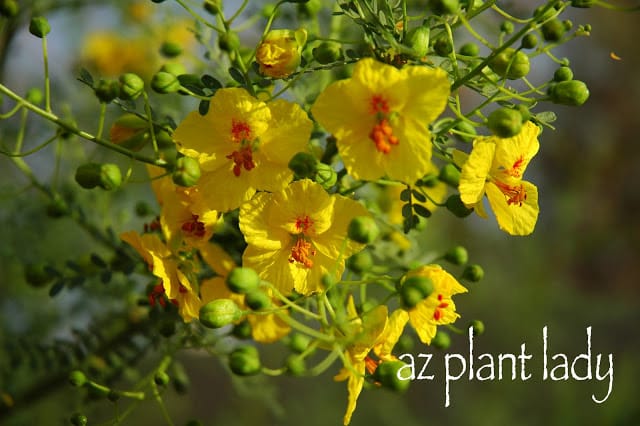
Desert Museum’ Flower
There Are Several Species of Palo Verde
There are three species of palo verde that are native to the desert Southwest; blue palo verde (Parkinsonia florida), formerly (Cercidium floridum), foothill palo verde (Parkinsonia microphylla), formerly (Cercidium microphyllum) and ‘desert museum’ palo verde (Parkinsonia x ‘Desert Museum’).
Another species of palo verde that is prevalent in the landscape are called palo brea (Parkinsonia praecox), formerly (Cercidium praecox). They have a dusty green trunk and branches that twist and turn. Their cold hardiness range is around 15 to 20 degrees F.
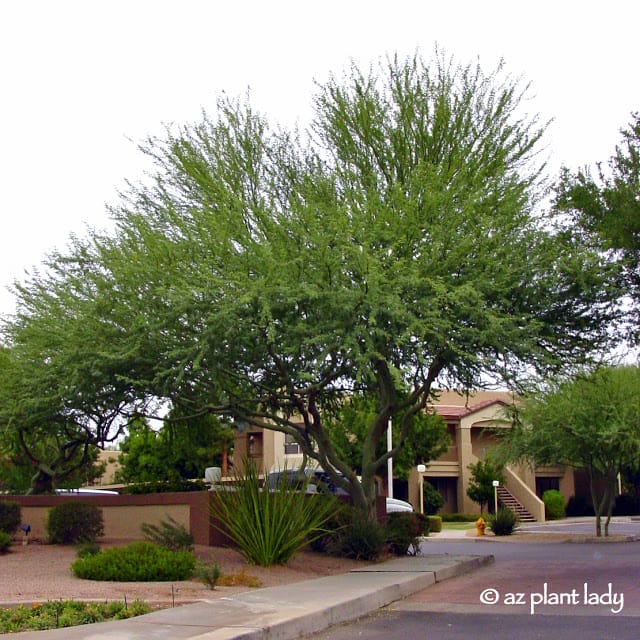
Iconic tree, Palo Brea
Palo Verde Landscape Uses
Palo verde trees serve as beautiful specimen trees where their green trunks, branch structure, and flowers serve as an attractive focal point in the landscape. They are drought tolerant, once established and provide lovely filtered shade year-round.
When deciding where to place your tree, be sure to take into account that they need a lot of room to grow, mature sizes are listed below.
Palo Verdes don’t do well when planted in grass and will decline over time. Locate away from swimming pools due to flower litter in the spring.
Because of their more massive thorns and branching tendency to point downwards, palo brea trees aren’t recommended in areas close to foot traffic.
Mature Sizes:
- Blue Palo Verde – 30 ft x 30 ft
- ‘Desert Museum’ Palo Verde – 30 ft high x 40 ft wide
- Palo Brea – 30 ft x 25 ft
- Foothills Palo Verde – 20 ft x 20 ft
As with many desert trees, Palo Verde trees have thorns, except for the ‘Desert Museum’ Palo Verde.
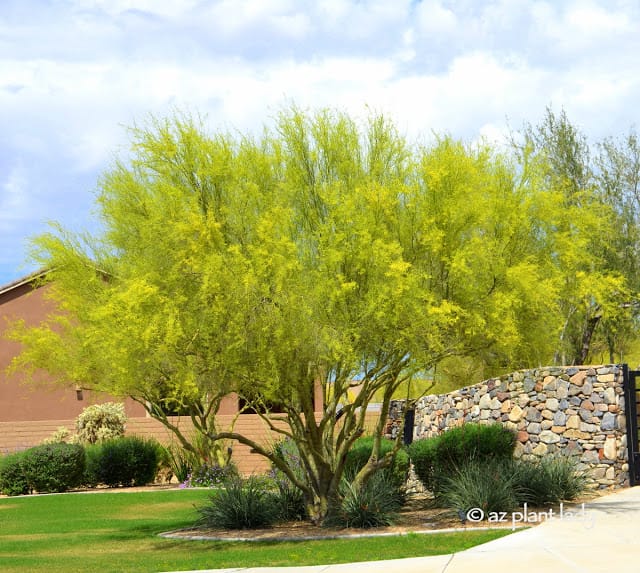
Foothills Palo Verde
Basic Palo Verde Maintenance
Pruning for Canopy Elevation and Structural Integrity:
Pruning Palo Verde trees in your desert Southwest garden is a crucial aspect of maintaining their health, aesthetics, and structural integrity. One of the primary objectives of pruning is to elevate the canopy, ensuring it remains well-balanced and visually appealing. This practice involves selectively trimming the lower branches to create a more elevated and open canopy. By doing so, you allow for better air circulation and light penetration, which can promote overall tree health and reduce the risk of disease.
Steering Clear of Hedging and Topping:
While pruning is essential, it’s equally vital to understand what not to do. Avoid two harmful practices: hedging and topping.
- Hedging: Hedging involves indiscriminate shearing or cutting of branches to create a uniform, artificial shape. This practice is highly discouraged for Palo Verde trees, as it not only compromises the tree’s natural beauty but also disrupts its growth patterns. Hedging can lead to dense, bushy growth with weaker, more susceptible branches.
- Topping: Topping is the severe cutting of the uppermost branches, often leaving stubs or bare trunks. This practice is detrimental to the tree’s health and stability. When Palo Verde trees are topped, they respond with a vigorous burst of new growth that tends to be weak and prone to breakage. Topped trees are also more susceptible to pests and diseases.
The Proper Tree Pruning Approach:
Instead, adopt a thoughtful and strategic approach to pruning your Palo Verde trees. Start by identifying dead, diseased, or damaged branches, and promptly remove them. This eliminates potential entry points for pests and diseases, promoting tree health.
Next, focus on elevating the canopy by selectively pruning lower branches. When selecting branches for removal, prioritize those with narrow crotches or those that cross and rub against each other, as these can weaken the overall structure.
Consider hiring a certified arborist or a professional tree service to ensure that your Palo Verde trees receive the care they deserve. These experts have the knowledge and experience to prune your trees correctly, preserving their natural form and promoting robust, healthy growth.
By following proper pruning practices and avoiding hedging and topping, you can help your Palo Verde trees thrive in your desert Southwest garden. A well-maintained Palo Verde tree not only adds to the beauty of your landscape but also provides valuable shade and habitat for local wildlife while remaining resilient in the harsh desert environment.
Palo Verde is My Favorite Tree
As a landscape manager, horticulturist and arborist, I have grown and maintained all of the palo verde species mentioned, and I truly enjoy them all. However, at home, I have 4 ‘Desert Museum’ trees.
In comparison to the other species, their trunks are a deeper green; they produce larger flowers, are thornless and grow very quickly in the desert. Also, they require little, if any, tree staking when planted. Simple amazing!

 Noelle Johnson, aka, 'AZ Plant Lady' is a author, horticulturist, and landscape consultant who helps people learn how to create, grow, and maintain beautiful desert gardens that thrive in a hot, dry climate. She does this through her consulting services, her online class Desert Gardening 101, and her monthly membership club, Through the Garden Gate. As she likes to tell desert-dwellers, "Gardening in the desert isn't hard, but it is different."




Yes, I think I also would prefer the thornless one! Thanks to you, I will know more Phoenix trees' names when go there to visit my relatives.
Hi Tatyana. Me too! I used to have a Palo Brea and it was very beautiful, but is sure did get some scratches from the thorns when I was not being careful.
Thank you for the comment!
Hello! I came across your page while looking for information on how to care for our Palo Verde tree. You mention that pruning is important. Can you please advise on when the best time of year for pruning would be, and how much we should take off? Any input is greatly appreciated!
Hello Barbara,
Thank you so much for your comment. Palo Verde trees are best pruned in June, once they have finished flowering. As a rule, you should not remove more than 20% of a tree's branches a year. To do so, would put undo stress on the tree, leaving it susceptible to disease and other stresses.
I hope this helps!
Noelle
Hi Noelle! Thanks for replying. I was hoping to do it during the cooler months but we'll just have to get up really early one morning in June and beat the heat. Thank you for the good info!
Best regards and happy holidays!
Barbara
Hi Noelle, thank you for this great site! We planted a Desert Museum Palo Verde 8 mos ago. and it's now approx. 12 ft tall and 9 ft wide. A neighbor recently suggested we consider "topping off" the tree if we'd like it to grow a thicker trunk. What are the pros and cons of topping off a Desert Museum Palo Verde? Thanks, John & Mary
Hello John and Mary,
I am so glad to hear that you have a beautiful Desert Museum Palo Verde. You will enjoy its beauty for years to come. I just love mine:-)
Okay….whatever you do, DO NOT top your Palo Verde tree or any tree for that matter. There are honestly no pros for topping trees. I do have plenty of cons though. First of all, topping DOES NOT lead to a thicker tree trunk. Furthermore, it stresses the tree by removing foliage that it has to work hard to replace, it leaves the upper branches open to sunburn, 'topping' actually causes your tree to grow back faster and the new branches have a weak attachement which can cause them to break off easily…there are many more reasons not to top and you can find them at the following link http://www.treesaregood.com/treecare/topping.aspx
I hope this helps 🙂
3rd time's the charm!
I have a DMPV in a bed with an almost-native grass meadow, a mix of blue grama & curly mesquite. If it's not irrigated will it be OK together?
Thanks!
Kimberlyn Drew
Hi Kimberlyn,
If your tree is newly planted in that area, it will need irrigation until it becomes established, which can take 1 – 2 years. Thereafter, it should be okay as long as you water it deeply 3 – 4 times during the summer.
Good Luck 🙂
Noelle
Thanks Noelle,
I was referring to your comment that PVs will decline if planted with grass. Is my combination OK? Both are pretty well established. The tree is at least 3 years old and doing well, and the area is primarily watered by rainwater runoff from the roof (passive rainwater capture system).
Thanks again,
Kimberlyn
(My first two comments had been more detailed, but it took me three times to get it to stick so I made the final message overly brief.)
Hello Again Kimberlyn,
The problem with Palo Verde trees grown in grass is largely due to the use of sprinklers. The water leaves salt deposits behind on the trunks, which can affect the photosynthesis rate. So, you should be fine since you don't use sprinklers. I think you are in good shape 🙂
Noelle
Noelle, I have a newly planted small size "museum" palo verde. We planted it in early Feb. We have been watering it once or more a week until it is established, but now the leaves are going yellow, & we think it's gotten too much water. Do you have any suggestions for me? I didn't water it at all this week, do we need to give it some nutrition or just back off and stop watering? Thanks so much, Amy
Hi Amy,
I think you are right that it has gotten too much water. RIght now, you are doing the best thing by not watering it and letting the soil dry out. Don't add any fertilizer – that will stress your tree even more because it will stimulate to work hard to produce leaves when its roots aren't large enough to support them.
You won't need to fertilize your Palo Verde tree at all through its life. They are used to growing in our soils. For its first year, I would water it deeply (3 ft) every 10 days until November, when you can then back off to once every 15 – 20 days.
I hope this helps.
Noelle
Hello! So glad I found this blog. I planted 2 DMPV trees about 18 months ago, and they haven't grown at all!:( They are blooming right now, but not a lot of blooms. I hardly water them, they got a lot of rain water this past winter, and I now water them about every other week. I live in Southern California. Not sure if I am doing something that is stunting their growth? Any ideas? Thanks! Tina
Hi Noelle,
Thanks for this resource! Quick question. I recety planted 3 DMPV 15 gallon trees. I swear the nuresry told me to give the tree a long watering that floods the 3 foot diameter little 'catch basin' on a daily basis.its day two and it seems a bit excessive. I already have a bit of yellowing on a few of the trees, but i assumed that was from a bit of shock from transplanting. How often, how long, and how much should i be watering them? Thanks.
Josh
Hi Josh,
I am so glad you are growing Desert Museum Palo Verde trees. They are by far, my favorite desert tree.
The nursery was correct in advising you to water your tree daily – I would do this for the first 4 days. Then you can gradually taper off to every other day for the next 4 days. Then you can go to 3 times a week.
I suspect that the yellowing leaves is a sign of transplant shock. It is always hard when plants are first planted, especially in summer.
Keep a close eye on your tree. You may need to adjust your watering schedule if the soil becomes water-logged.
I hope this is helpful 🙂
Noelle
Hi Noelle! I too am glad I found your blog. I recently bought a vacation home in Lake Havasu City, AZ, and am so excited about the prospect of nurturing a desert garden. At the same token, I'm a little worried I'll destroy what has been established. There's a large PV in the front yard, the focal point of the garden. With infrequent summer visits, I am afraid the tree will die without manual irrigation, yet we haven't had time to establish a timed system. I've soaked the tree basin about once a month so far and as of last week, it looks pretty good. Should I worry?
Hello 'Arid',
Thank you so much for your question. If your Palo Verde tree is established (over 3 – 4 years old). It will probably do fine with infrequent irrigation.
If you have irrigation on plants that surround your tree – your tree will get some water from that.
However, desert trees need deep, infrequent irrigation. When you water, you want to focus on applying the water where the branches end (where they reach out too). This is where most of the roots are located.
Using a hose on a slow trickle, let it thoroughly soak the area for an hour or so and then move to the next area so that the entire outer circumference of the tree is watered.
Water to a depth of 3 ft. You can test how deeply you are watering by using a piece of rebar and pushing it into the soil after watering to see how deep the water penetrates and if you need to apply more.
I hope this is helpful 🙂
Noelle (azplantlady)
Hello. I live in Scottsdale, AZ I have 3 large desert museums in my yard and they are very healthy. The lower branches are really starting to spread out and getting a little low over my pool and over my driveway. I am going to have them professionally pruned, but it's the beginning of September. I read that you recommend June for pruning. Will they be okay if pruned in early Sept?
Thanks!
Hello Amber,
Actually, I just had to do the same thing to my new Palo Verde tree. You can prune it a little right now – but try to avoid pruning any more then you have too.
In a given year, you should never prune more then 20% of a tree's branches.
Good Luck!
Noelle
Thanks for sharing! I recently just planted the first pic of the desert tree in my yard. I love how the trunk and branches are green. It makes it look like there's moss which would give the year the illusion that you don't actually live in a dry desert wasteland 😉 I did just mulch my yard, will that hurt the tree?
Hello Carter,
Too much mulch near the tree can cause problems. An inch of mulch will be fine over the root zone of the tree (the part underneath the tree canopy from the trunk out to the outer branches). Keep mulch at least 6" away from the trunk of the tree or else you can have problems with fungal infections of the trunk.
Good luck!
Noelle / azplantlady
I feel lucky to have found this page. My wife and I bought a 5 gallon palo verde on Sunday. My goal was to get it in the ground quickly. I planted it, unfortunately at 2 pm it was about 85 degrees. I included miraccle grow soil for trees and shrubs at the bottom and sides as well as with the soil it had in the planter. The hole I dug is roughly 3 ft deep. It was really hard to dig that hole as the ground is really hard here in AZ. I used water to help with the digging so the hole would be moist for planting. We watered that night, Monday and Tuesday at least 5 gallons of water each time. After reading some things on the internet I did not water it last night. The soil appears to still be damp. The leaves are turning yellow now but the yellow flowers are still blooming. We gave it a vitamin mixture in the water on Tuesday.
My question is have we gave it too much water or not enough? Did we make a mistake with the vitamin additive? Is the soil we put it in ok? What can I do to ensure it survives? Please help, my wife will be devastated if we lose this tree. We planted one previously two years ago with no success, but I am certain it is because the dogs peed on it constantly. We are protecting this new tree so that they cannot go near it.
I feel lucky to have found this page. My wife and I bought a 5 gallon palo verde tree on Sunday. My goal was to get it into the ground quickly so after digging the hole (4 hours) we planted it around 2 pm. It was about 90 degrees that day. The soil was hard to dig, so we also purchased a bag of miracle grow soil for trees and shrubs. We watered it that night, Monday night and Tusday the leaves had turned yellow so I purchased a vitamin mixture for the water and watered it Tuesday night. 5 gallons each night. after reading a few other things on the internet and did not water last night. The ground is still damp about two inches underneath the top soil. The leaves are almost all yellow and it appears as though it may not make it. Which would devistate my wife as she has always wanted a palo verde tree.
Have we over watered? did the vitamin mixture make the shock worse? at this point what can I do to ensure it survives?
Hello Crimsonidle,
You have asked some great questions. Palo verde trees are easy to grow, aren't fussy and don't need any special soil or vitamin mixture.
All plants suffer transplant shock when planted. That and/or the condition of the tree when you bought it could be the reason that the leaves turned yellow. The leaves will fall, but should be quickly replaced by the tree.
Trees should be watered to a depth of 2 – 3 feet. Here is a helpful timetable created by experts for watering new desert trees: Every day for the first week, twice a week through June, 2X a month July through October and once a month in winter.
Next year, water 2X a month spring through fall and once a month in winter.
As long as the branches stay green and leaves begin to grow back, your tree should be okay and recover. However, if you notice growing of the branches, then I would recommend starting over.
Good Luck!
Noelle 'azplantlady'
Back in the Spring,I planted a 20 gallon palo verde, here in SoCal, a few miles from the Desert. It was sort of thin but already had some flowers when I bought it. I filled the hole with water when I planted it. One day weeks later I noticed that all the leaves were gone, such that I thought either they all fell off or something ate them. However upon close inspection I have seen neither bugs of any type nor honey-dew on the tree. I thought I had maybe been under-watering, so I started watering more, 2 or 3 times per week, and fertilized. In a week or so I noticed new foliage growth…for about a week, then suddenly AGAIN, all the leaves, GONE. This has happened twice now. Help?
Hello Bob,
The first time you lost the leaves is most likely due to transplant shock. All plants go through a type of shock when being moved from one environment into another. Any jostling of the roots can increase the problem and can lead to leaf loss.
The second time you lost the leaves was due to overwatering. Also, palo verde trees do not need fertilizer – they are adapted to growing in poor soils with low nutrients.
Here is a general guideline for watering new trees:
First year –
Every day for the first week
Twice a week through June
Once a week from June until fall
Twice a month in fall and spring
Once a month in winter
2 – 5 years after planting-
Twice a month spring and summer
Once month fall and winter
I hope this helps!
Noelle 'azplantlady'
Hello Bob,
The first time you lost the leaves is most likely due to transplant shock. All plants go through a type of shock when being moved from one environment into another. Any jostling of the roots can increase the problem and can lead to leaf loss.
The second time you lost the leaves was due to overwatering. Also, palo verde trees do not need fertilizer – they are adapted to growing in poor soils with low nutrients.
Here is a general guideline for watering new trees:
First year –
Every day for the first week
Twice a week through June
Once a week from June until fall
Twice a month in fall and spring
Once a month in winter
2 – 5 years after planting-
Twice a month spring and summer
Once month fall and winter
I hope this helps!
Noelle 'azplantlady'
My Palo Verde tree about six weeks ago lost all of its leaves. The branches also have all these small bumps all over them. I have another Palo Verde in My back yard and front yard which both are healthy. There is also some brown spots developing from the trunk outward toward some of the branches. Is there anyway to save it? Any help would be greatly appreciated
Hello Ted,
I'm sorry to hear about your palo verde tree. The fact that it lost its leaves points to some sort of stress. Palo verde trees are known to lose their leaves during times of drought, however, there can be a host of other problems that are causing the brown spots, including insect damage.
I advise you to enlist the services of a certified arborist in your area who can look closely at your affected tree as well as those that are just beginning to show signs.
I hope this helps!
Noelle 'azplantlady'
I am an arborist in Los Angeles and I have a client with a underperforming 'Desert Museum'. I was called to their house in November approx. 8 months after the tree was planted; a 48" box from a reputable local nursery. The leaves have turned from green to grey, and much of these grey leaves fail to fall off the tree. They said the tree was planted in the pit atop a mound of gravel and filled in with native soil. The gravel concerns me, as I would never recommend this practice. I told them to turn off all irrigation until March.
We are now in March and the owner has stated that the tree has begun to sprout new leaves, but again, they are quickly turning grey. Do you have any clues as to the problem?
Hello Steven. It sounds like it is being over-watered. Here is a link where you can find recommended watering guidelines for desert trees – both newly planted and established. http://www.amwua.org/landscape_watering_brochure.html
Following the recommended watering schedule should help your client's 'Desert Museum'.
Noelle
Hi,
I live in Southern California, Orange County. I just bought the 15 gallon Desert Museum Palo Verde. This is my first time planting this tree.
It is July now so should I wait until October to plant it in the ground? Can I plant it close to my lawn area? Hw long can it stay in the 15 gallon pot?
Thanks,
Cathy
Hi,
I live in Southern California, Orange County. I just bought a 15 gallon Desert Museum Palo Verde tree, this will be my 1st experience planting this tree.
It is July now so can I wait until October to plant it in the ground? Can I plant it near my lawn area? How long can it stay in the 15 gallon pot? and should I prune the branches a few feet shorter?
Thanks,
Cathy
I just rescued one from the clearance aisle at a Big Box store. My zip is 92345. Should I keep in my garage until Spring or can I plant now? Will it need special frost protection this winter?
Hello Mrs. Heald,
You can go ahead and plant it now since fall is the best time for planting. Protect it from freezing temps through its first winter and enjoy this lovely tree.
I hope this helps!
Noelle 'AZ Plant Lady'
I planted a 5 gal. size Thornless Palo Verde several months ago. Some of the leaves are turning yellow. I planed a 2nd tree at the same time, and the leaves on that tree are maintaining the green color.
Thank you for any advice.
Bob Autrey
Hello Bob,
It sounds like you can be having a problem with one of your trees being planted too deeply. Dirt often settles after planting, causing new plants to sink down slightly. Lightly scrape away the soil underneath the tree until you see tiny roots or the trunk begins to slowly flare out.
I hope this helps!
Noelle 'AZ Plant Lady'
Thank you for the great resource and all the helpful information! We live in Midland, TX and bought two 15-gallon Desert Museum Palo Verdes in December, getting them in the ground December 26th (on a very warm day). We noticed a few weeks ago that the bark of both trees had been chewed by (presumably) some rodent – one tree has lost bark entirely around the main trunk, and the other tree has lost it around most but not all of the main trunk. The trees had been green and leafy but are now shriveled and with brown leaves. Do you have any recommendations what we should do from here? Some have told us to simply cut the trees both down to the ground and let them spring back up (but this time with some rodent protection!). Is there any chance we can salvage both trees as they are? Or are they both completely goners? I suppose our inclination may be to cut them to the ground in hopes they'll bounce back nicely and with their trunks fully intact, since even if the trees survive as they are I imagine they'll have large, permanent scars where they have been chewed away, which would of course not be our preference; however, we are totally new to Palo Verdes and relatively new to desert xeriscaping so we welcome whatever advice you may have to offer. Thanks very much for your time and help!
Hello Scott,
You will need to cut the tree that has been chewed all around back t the ground since it can't transport nutrients. Since you have two, I would get ahead and do the same with other one. The should great w back nicely and as they blow, select 3 main branches (stems) to allow them grow into the new tree and prune the rest away.
You will enjoy your palo verde trees and I hope that your are able to keep the rodents at bay.
Best,
Noelle
Hello Noelle,
My research on PVDM's landed me here on your cool site!
I live in the SF Bay Area (zone 9b) and am contemplating replacing 3 large and messy eucalyptus trees with a PVDM but wondering about 2 things:
1. How messy are the flower and leaf droppings (broadly speaking)?
2. Since PVDM is a sterile hybrid, is there any pollen still? If so, is this pollen generally an allergen?
Looking forward to your response.
Marc
Hello Marc,
Thank you for your question. I apologize for not addressing it sooner.
Desert Museum Palo Verde trees are a rather clean tree other than in late spring/early summer when its dropping flowers cause a mess.
From what I have heard from several experts, Desert Museum palo verdes don't cause allergies. Rather, trees with smaller pollen do.
I hope that this helps you in your decision.
Best,
Noelle
You are very welcome!
I am thinking of planting a Desert Museum Palo Verde but keeping it as a big bush because of the location: the "bush" will be situated at a corner of the property, about 4 ft away from cement block walls and intended to distract people from the "ugly" look of the block walls. However, I read from your previous comments that the DMPV should not be topped off. Is there a way to keep the plant small?
Thank you for your help.
Van.
I am thinking of planting a Desert Museum Palo Verde in a corner of the backyard, about 3 to 4 ft away from the block-wall fence. The intention is to distract people from the "ugly" look of the cement blocks, so I want to keep the DMPV bushy and low. However, you mentioned in earlier comments that the tree should not be topped off. How do I keep the tree small then? Please help. Thank you very much.
Hello VP,
Unfortunately, the Desert Museum Palo Verde is a poor choice for planting so close to the wall. They can grow 30 to 40 feet tall and wide and there is no way to keep it small without constant pruning, which is detrimental to the tree's health and appearance.
I recommend selecting a large shrub that has been pruned into a tree to fill that area instead and screen out the ugly block wall.
I hope this helps 🙂
Noelle – AZ Plant Lady
Thanks, Noelle, for your advice. I will find another spot fot the DMPV for I like it so much. Back to square one to find a cover for the block wall. 🙂
Is there anything you can suggest? I'm in usda zone 10b.
Thank you again.
VP.
Hello Again VP,
The best advice I can give you is to visit your local nursery and look at large shrubs that have been pruned into trees. Make note of the ones that you like and research how large they become. You are looking at one that is approximately 10 ft. wide or smaller. If you want to plant a tree 4 ft. from your wall, your best bet is using a large shrub, whose roots are less likely to cause cracking or problems with the wall.
It's best to avoid planting something that will grow too large and have to remove it later. Again, I hope this helps 🙂
I'm so glad that I found this site, and I hope that you can help us! We have a PV in the front yard that broke during a windstorm. The remaining portion couldn't be cut in a safe way, so it was cut back to a 3' stump and left to sprout (our HOA requires a tree there). Well, it's sprouting like crazy! So many sprouts and they're heavy–the tree looks like a shrub right now. How do we maintain the tree in a way that encourages healthy growth back into a tree (and not this crazy sprouting thing)? Many thanks for your advice!
Hello Goldie,
I would select 3 of the largest sprouts, making sure that they are evenly spaced around the trunk. Then prune off the others. Allow the three to remain and removing any new sprouts from the trunk. As the remaining sprouts grow, they will form new branches. Gradually, prune up the new branches on the three main branches as needed to create a tree shape.
I hope this helps!
Noelle:
Thank you so much for your wonderful, informative, and practical blog. We are relatively new to the desert (Chandler, AZ) and one of our favorite things about our home is the beautiful DMPV that is the centerpiece of the front yard. The tree is boxed in on three sides – 12' from the front of the house, 10' from the driveway, and 8' from the sidewalk. The fourth side is unrestricted. For the past two years, I have been pruning as little as possible, only enough to keep it off of the roof of the house and car, providing clearance for pedestrians, and thinning out where branches are criss-crossing. The tree has two trunks over a foot in diameter and two smaller trunks about 4" in diameter. Each of the large trunks has four large branches that spread out nicely at about 5", creating the canopy. The smaller trunks grow out from the base of the tree at 60 degree angles and then level out over the sidewalk and driveway. Their branches do not provide any of the canopy. I have received unsolicited advice that the two smaller trunks should be cut off. Cutting off the smaller trunks would make the maintenance pruning marginally easier, but I don't want to risk injuring our tree. Would the tree benefit in any way by cutting off the smaller trunks?
Hello Paul,
Welcome to Arizona! Your tree sounds beautiful and your descriptions were helpful. You can go ahead and prune off the smaller trunks, keeping the priority in keeping the 4 major branches. The guideline for how much to safely remove from a tree is to prune off NO more than 20% of a tree's branches/foliage in a given year. That should help you as you move forward in deciding on what you can keep and safely remove. When in doubt, I recommend that you entail the services of a certified arborist, who can help. If you need the name of someone in your area, just let me know and I can give you a referral.
I hope this helps!
Noelle – AZ Plant Lady
Noelle:
Thank you very much for your advice. Other than the smaller trunks, all I need to do is a little thinning to provide clearance for the sidewalk and house, so I'm not close to 20%.
Noelle,
I just planted a 15 gallon desert museum in my backyard in Long Beach, CA. It came staked with a single bamboo stake in the center tightly wound with green tape. The local nursery said that they recommend that it remain staked until the branches are more substantial. Everywhere i have seen on the internet says that this makes for weaker branches. Any recommendations for the amount of time it should remain stakes or not staked at all? Thanks.
James.
Hello James,
Great question! It is a good idea to stake the tree for the first year after planting. However, the little bamboo stake isn't the way to do it. Go ahead and remove it and put in two sturdy stakes on either side of the tree. Here is a link on how to stake trees: http://www.treesaregood.com/treecare/resources/new_treeplanting.pdf
Congratulations on your new tree. You will have many years of enjoyment.
Noelle – AZ Plant Lady
Hi Noelle,
I live in Southern California and was planning to plant a 15 gal DMPV in our north-facing front yard, which gets full mid-day sun in the summer. However, with sun getting lower, I now realize that in the winter, the entire yard is in full shade! Will it be okay to still plant there? Thank you in advance for your advice.
I just bought a home with a Palo Verde Tree in the Back yard. The yard was a mess and the local gardener came and pulled out most of the plants and trimmed several branches from the tree. It looks much better, but he did not put anything on the trunk where he cut the lower branches off. Should something be put on the cuts?
Hi Arleen,
Great question! You don’t need to put anything on the cuts. Research has shown that tree cuts heal faster when nothing is put on them. I hope this helps!
Hi Charissa,
They do best when in full sun. I’m not sure how it will do in the shade through the winter months. I would go ahead and try it because if it works, it will add beauty to your outdoor space.
I live in San Bernardino County and recently planted a 15 gallon Desert Museum Palo Verde in my front yard. When I removed the plant from the nursery container the bottom half of the soil separated, from the remainder of the soil. The bottom half seemed to be all dead root. I went ahead and planted the Desert Museum and saturated the soil . About 1 week has past and now I have notice that the leaves are turning yellow and falling off . The soil is still damp .( the area that I live in has expansive soil condition). Is the plant stress from the transplant ? and is it bad to have the roots in the soil that is damp? I have not watered the Desert Museum for over a week. I was worried when the soil fell apart that it could kill the plant. Should I leave the plant alone and let it get over the shock of the transplant?
Hello Ed,
It is a common problem that people often report when planting a new Desert Museum palo verde. It is likely caused by the shock of being transplanted and losing some of its roots. It still should be watered. Here is a general guideline for watering newly planted desert trees: Twice a week through June, once a week July – September, twice a month October – November, once a month December – February, and twice a month, March – April. These are guidelines only and adjustments may need to be made.
I hope this helps!
I live in the high desert in Palmdale, CA. I had two 15-gal.Desert Museum trees installed mid-summer last year. One of the trees still has green branches and trunk, but has not begun to leaf out just yet, so I’m a bit concerned about that. At the moment, the weather in my neighborhood is warm and sunny one day and cold and windy the next. Spring has not quite settled in. However, all but two lower branches on the other tree have turned brown as well as about half of the trunk itself from the top down. A couple of the lower branches still show a little green closer to the what’s left of the green portion of the trunk. This particular tree did seem to struggle somewhat after being transplanted, and things just got worse as time went on. Rather than replacing the tree, it was suggested that I promptly remove all brown branches and trunk and wait to see if what’s left of the remaining green branches and trunk come back. I would so appreciate your opinion of this strategy.
Hello Janet,
I’m sorry to hear about your tree. Unfortunately, chances are that the one that is turning brown, will not survive. However, there is a chance that pruning away the brown areas will stimulate new growth on the green sections so your tree can survive. So in answer to your question, “yes” go ahead and prune away the brown section, but realize that it may not be enough to save the tree.
I hope this helps!
Thank you so much. I did trim off the brown branches and trunk and I’m keeping my fingers crossed. You are the best!
Oh, thank you for your kind words, Janet. Please let me know how it does.
I live in West Sacramento and planted two 2 1/2 foot tall desert museums about two weeks ago. The trees had a bunch of white spots on them that looked sort of powdery. Some of the branches also had dark brown spots. The nursery said that this should not be a cause for concern. After about a week, I noticed that most of the tips of the smaller branches turned white and were very brittle so I pruned off this area (about 1/2 inch). I have also noticed a couple of spots with pink colored powdery like spots. This winter has been super rainy in California and the area I planted in was super saturated clay. I have not needed to water yet as the soil is still really wet to the touch and the pots they came in were also really wet. I dug out 2 times the pot size and amended with fur mulch. Are the problems i’m experiencing due to transplant shock? They barely have any leaves and it’s almost May.
Hello Jason,
I haven’t heard about with or brown spots on Desert Museum palo verde trees. This could be due to the differences in our climate. It is normal for them to suffer from transplant shock. I would keep an eye on them for the next couple of months for a worsening of symptoms.
Hi!
I planted a 5 gallon dmpv last week. I live in Southern California. I used a potting soil and mulch mix. Depth was the same as the 5 gallon pot and width was 1.5 of pot. The native soil is sandy. I watered the first 4 days. Today, which is 6 days from the day I planted it, I noticed some of the branches are brown and dry. Mainly the ones that are the highest. The plant is still flowing. The weather here has been in the mid 70s. Did I do something wrong?
Thanks
Hi!
I planted a 5 gallon dmpv last week. I live in Southern California. I used a potting soil and mulch mix. Depth was the same as the 5 gallon pot and width was 1.5 of pot. The native soil is sandy. I watered the first 4 days. Today, which is 6 days from the day I planted it, I noticed some of the branches are brown and dry. Mainly the ones that are the highest. The plant is still flowing. The weather here has been in the mid 70s. Did I do something wrong?
Thanks
Also, when I took it out of the 5 gallon pot, half of the root ball broke off into the hole. Will that damage the tree? I noticed today that alot of the small needle size branches are turning yellow/brown and falling off. Is that normal? Is it from over watering?
Hello,
I hear very from many other people who have had similar experiences to yours after planting. Often, the tiny leaves do turn yellow and die to transplant shock. If half the root ball fell off, that will make the stress from being transplanted more severe. For desert gardens, I recommend tapering off waterings to twice a week (once it has been in the ground for a week). In July, water once a week. In fall and next spring, water twice a month, and in winter, water monthly. After a year in the ground, water twice a month.
While I am not an expert on watering trees in SoCal, the guidelines that I have provided, are for trees grown in the desert. Where you live, they may need even less. When watering, it is important to water to a depth of 3 feet.
Even if your tree loses most of its leaves, don’t despair. Often the grow back. If you still have questions, you may want to contact a master gardener in your area. I hope this helps!
Noelle:
A year has passed since I pruned two small trunks from my DMPV and it is doing great! Previously, I have done annual pruning, being very conservative as to what and how much I removed. Because of the size of the tree , I have decided that a professional should do this year’s pruning. So, I would like to take you up on your offer to recommend a certified arborist in the Chandler, AZ area
Hi Paul,
I am so glad your tree is doing well! I recommend the folks at Top Leaf – http://www.topleafaz.com They do my trees as well as my clients and I have been very happy with them.
We had a 15 gallon Desert Museum Palo Verde tree planted in February of 2006 in our front yard in North Central Phoenix. The tree was barely 6ft tall and we were unprepared for how fast the tree grew. It would have been more appropriately sized as a solo tree in the front yard. Not only was the tree gigantic it produced massive amounts of flowers several inches deep every day during the spring and into summer. It grew so tall the flowers went over our roof and into our pool creating a mess almost daily in the pool as well.
To top it off last winter I noticed my concrete driveway 4 feet away developed large cracks and lifted up big sections making a dangerous walking situation. Then I noticed cracks developing in my garage floor that coinsided with the cracks in driveway.
So before I lost my whole driveway and garage floor, I had the tree removed. I guess I would warn anyone planting a DMPV I would not plant close to any structure you don’t want eventually destroyed. I don’t know whether we contributed to its massive growth or that is normal for this type of tree.
Hi William,
You have brought up a great point about choosing trees. It’s important to know how tall and wide it will reach at maturity. DMPV trees do get tall and wide quite quickly. If they receive too much water, they can outgrow their normal mature size. It’s also equally as important where to locate large trees, which should ideally be placed at least 10 feet from any buildings, walls, and sidewalks, if possible.
I live in southern California and we planted a 5 gallon PV a few years ago. It is doing very well – green and blooms yearly, it has grown to about 15 feet tall. Our problem is we must move the tree to another location in our yard as it is too close to our patio wall. What is the best way to transplant the tree without risk of killing it? Is there a specific time of the year to transplant? Are there any precautions we should take when moving?
Hello Mary Ann,
It can be difficult to transplant a tree, even under ideal conditions, but here are some guidelines. The best time to transplant is in winter. Water the tree well a few days before transplanting. When digging up the tree, keep as much of the soil around the roots as possible. The roots extend to where the branches end. After transplanting, create a temporary basin around the tree that extends to the drip line (where the branches end). Water deeply three times the first week, and then twice a week for the next three weeks before slowly weaning it back to its regular watering schedule. It’s normal for some leaves to yellow and fall due to the shock of transplanting. I hope this helps!
I live in South Tx and have a 5 year Palo Verde tree.This year it is slow to bloom. It is late April and I see some yellow flowers and some green leaves returning, but I am worried because by now it should be in full bloom. I do not see any dead branches. We did have a abnormal cold winter and it snowed. We have not had snow in 20 years. Should I just be patient?
Hello Loretta,
It does sound like the palo verde tree was affected by the cold winter. Because of the unusual weather and the fact that it isn’t flowering as usual, means that the two are probably connected. As long as the leaves are growing back, it should be fine.
Hi Loretta,
I live in zone 8 Central Texas. I bought a 15 gal DM PV about 4 weeks ago. I have kept it in the pot for I do not have a suitable full sun area to plant it right now plus like the look of the container plant. Anyway, it is in a sandy loam and seems to dry out quickly. I use a chop stick and take it out to monitor and the soil is never soggy a few hours after watering. I was watering every third day then it dropped its leaves. I checked and the soil was dry so I went to every other day watering. It started to grow back leaves then dropped again. It does have two flowers on it though. So two questions please:
1) Can I leave it in the pot and let it be a container plant? What should I do about watering and the leaves dropping? Its only going to get warmer here. Thanks very much. Giani
Hello Giani,
Great questions. First, the leaves are falling because they are receiving too much water. I’ve never seen them grown in pots before and would advise against it. They grow too large and their roots will likely become encircled and root bound. The answer as to how much to water is difficult due to variable factors – weather, sun exposure, etc. I would talk to the nursery where you bought it and ask how often they watered it. I hope this helps!
Hello. What causes the desert museum tree bark to start splitting? BTW – thx for all of your previous advice when you visited our home.
Thanks very much. I was not deep watering when I did water it. If I do get it in the ground ,do I need to Admend the soil? Do I need to wait until fall ?
Hi Giani,
You should plant it now, which will help it through the summer as the soil is cooler. Don’t amend the soil, but dig the hole 3X as wide as the rootball, but no deeper than the root ball. I hope this helps!
I’ve notice my thinner palo verdes branches are starting sag and look more “willow like”. What could be causing this to happen?
Hello Jason,
If your tree is in flower, the weight of the blooms causes the branches to droop, which is temporary. Once the flowers are gone, they should spring back up. If they aren’t in flower, it could be that the branch is too heavy, which can be remedied by pruning it back by 1/3 it’s length. Hope this helps!
i have decided to purchase and plant some thornless palo brea (desert museum ). When planting these trees how far from the block wall would you recommend planting the trees, also how often does one water these trees and what months would you recommend planting? I live in phoenix, Arizona
Hello George,
Desert Museum palo verde trees aren’t palo breas – those are another kind of palo verde with thorns. Desert Museum palo verde trees are a hybrid tree with three different palo verde trees as its parents.
It is a great tree to use in the garden, but it does get big, so it’s important to all enough room for it to grow. Its average size is 30 feet wide and tall, so you want to plant it at least 10 feet away from a wall or your house. Because it is a desert tree, it can be planted in spring, summer, fall, or winter.
In regards to a watering schedule, I will email you a page from one of my favorite desert gardening books, which has a good schedule to follow.
Here is to many happy years enjoying the beauty and shade of this lovely tree!
I have a DMPV which is 2-1/2 years old. It’s growing well, very leafy with tons of yellow flowers. I live in Manhattan Beach CA and the weather is temperate and mild most of the time. The trunk of the tree and two or three of the lower, but larger, branches are turning brown. I saw a very old and large Palo Verde at the South Bay Botanic Garden in Palos Verdes and it had a brown trunk. I thought perhaps this browning was natural but after reading various articles, it appears not to be.
The only problem my tree has had is a mild attack of inch worms which we stopped by spraying with BT. The tree is planted in sandy soil on a slight incline. I have it pull back a bit and it has straightened up. I water it once per week. The leaves are bright green and healthy.
You told Janet of Palmdale that her tree which was browning would probably die. Am I in the same situation?
Jeannette
Hello Jeanette,
While it isn’t unusual for old palo verde trees to turn brown with age, it’s not normal for younger trees. So, the browning trunk does indicate some problems. It is hard to tell you what is wrong with your tree as the growing conditions and pests are different in California than in Arizona. I recommend that you talk to a certified arborist your area or nursery professional – they should be able to help you.
Hi Noelle,
I have a PVDM and one day it dropped all of its leaves and now branches are turning brown. Do you know if we have borers in Southern California? What do you think caused this? This tree has been in well-drained sandy loam for two years. The same thing happened to the PVDM before it and that one died. One-by-one all of the branches turned brown and died. I might have over-watered but it wouldn’t suddenly collapse like that, would it? I have Googled myself silly and I cannot get answers. It was beautiful in the spring.
Hello Sharon,
I’m sorry to hear about your Desert Museum tree. I’ve heard this happening several time in the Southern California area. I haven’t seen that happen in the desert climate. I recommend contacting a certified arborist in your area who may have some insight as to what is causing it. Over-watering could definitely be a factor. These are desert trees and do best with deep, infrequent watering.
Hi Noelle,
I’m considering planting a PVDM in my front yard. I’ve seen a few of them out here in Riverside, CA. One in particular (not sure what variety) has more of a traditional tree shape, i.e., it has one main trunk that then sprouts branches, say, 5 feet from the ground. And yet, all the other PVDMs I’ve seen for sale tend to be multi-trunks, i.e., they tend to have two or three trunks branching out close to the ground in more of a V-shape.
So, my question is: Can I shape a multi-trunk PVDM starter tree into a more traditional looking tree by pruning off its multi-trunks and favoring one main trunk? Or would this stress out a small starter tree too much?
Thanks,
Christian
Hello Christian,
You can try to find a ‘standard’ ‘Desert Museum’ palo verde tree, which is one that has been trained with a single trunk. However, the reason that they are hard to find is that they are more susceptible to breakage in wind. Multi-trunk trees are more resilient as the overall weight of the tree is dispersed among several branches, so I do recommend that you get a multi-trunk form.
Thanks Noelle. Lovely photo of you btw. I just planted a new one that is by itself on a slope so I will water deeply and infrequently since there are no other plants around to worry about. Fingers crossed!
Hello Sharon,
Happy wishes for years of beauty with your new palo verde!
I live in Long Beach CA & bought 2 desert museum trees 2 1/2 years ago, they were fairly large but not sure the gallon size, they were $100 each at a nursery. 1 died about 4 months ago, I tried everything to keep it alive with no luck. The 2nd looks like a bush, still with no trunk, but pretty green and few flowers throughout the year. Please tell me how to trim the tree to get a trunk, and how to get it to flower more. We water it once a week with a good soaking like the nursery told me to do. It’s in pretty good sun most of the day. Help. Thanks.
Hello Sheila,
I’m sorry to hear that you lost one of your Desert Museum palo verde trees. In regards to pruning it into more of a tree form, you want to concentrate on gradually lifting up the canopy (the upper part with all the leaves and branches) of the tree. To do this, remove the lower, smaller branches back to the trunk. You want to concentrate on keeping the 3 main trunks and remove any smaller branches that may grow on the lower third of the tree. As the tree grows taller, you will continue doing this, gradually lifting up the canopy (if desired) so that it begins at roughly halfway up the tree or a bit more. I hope this helps!
Thank you Arizona Plant Lady for clarifying what I should do with my 1 remaining living Dessert Museum tree. Of course I have 1 more question, to take my 3-year-old tree that still looks like a bush with no trunk to 1 that looks like a tree, I understand that I now have to remove some of the lower smaller branches from the bottom, but can I do it this month, in December? Or do I have to wait till the Spring? Again, I appreciate your help, as I don’t want another tree that I love to die.
Hello Sheila,
If you live in a frost-free location, go ahead and do it now. Otherwise, wait until late winter/early spring once the danger of frost has passed.
I absolutely would encourage people to be sure to plant their trees a proper distance > 10ft from sidewalks, walls, or driveways. I purchased a property that already had a lovely Palo Verde shading my patio. 3.5 years later, my HOA most likely will be removing it. The tree is gorgeous, and has been growing like wildfire! The root system is raising the asphalt entrance to my carport, and I have a couple of large cracks in the carport concrete floor. It is probably just a matter of time, before it will cause havoc with the patio wall, or even the wall to the carport. I will surely miss the lovely tree, and the shade it provides. It certainly wasn’t given much thought when planted, and I will need to look into an appealing planting that won’t cause a similar problem. Any suggestions are welcome. I live in Southern AZ.
Hello,
Great tips! In regards to what to plant in their place, the following link is a great resource that can help you select a tree for your Arizona garden. – http://www.amwua.org/plants/trees.php
Thanks so much for you input. Do you have any suggestions regarding a bush replacement (vs tree), that would be lower. I have a Mountain View from that patio. I’m now leery of trees in that spot, due to the roots; however, I will keep an open mind. Thanks! 🙂
Hello,
I would go with hop bush or orange bells 🙂
Thanks so much….I will look them both up. I appreciate it!
Hi, I have a volunteer palo verde(I think) in my yard. Not sure what kind it is. I don’t want to pull it out, but I don’t have much room for it. Is it possible to keep it small, or transplant to a big pot so it might stay smaller? Right now it’s just like a tall piece of grass with fernlike ends. Thanks!
Hi Carla,
Unfortunately, you can’t keep it small – it will suffer and eventually die in a container as this desert tree isn’t meant to be planted in containers. Palo Verde trees send out many volunteers, which is a natural part of their life cycle and you don’t need to feel bad about pulling it out. 🙂
Thanks, that makes me sad. But I guess better when it’s small, rather than cutting it when it gets bigger.
Hello, we just bought a house near Palos Verdes in the Los Angeles area and we have a Palo Verde tree in our yard. I have two questions. The leaves are all silvery; we got a ton of rain this last winter, could that be the reason? The ground around it was completely covered with succulents, but I ended up pulling them all out. What I found in the soil under the succulents was an alarming mass of bamboo roots and shoots all over the area. (We have bamboo growing about 10 feet away.) Do you think that getting the succulents and bamboo roots out of there will be a good thing for the Palo Verde? Also, it is planted pretty close to the house; could the roots create a problem with the foundation? Thank you for your help.
Hello Windy,
You certainly live in a beautiful area! My parents lived in San Pedro for several years and we enjoyed our visits there. From your description, it appears that there are several issues. Many plants are reacting to the above normal rainfall. The more important issue are the bamboo roots, which can affect your palo verde tree as they are both fighting for nutrients and water. Normally, it isn’t a problem having succulents or ground covers growing underneath it, but if it is stressed, it’s probably best to remove those elements. In regards to the roots, they aren’t known for having an invasive root system but any tree can cause foundation problems if they are too close. I recommend consulting with a certified arborist in your area who can help determine the best way to manage your tree for its health and beauty.
Hi- thank you so much for your quick reply. Yes, we live in San Pedro. We are very excited about our new yard; there are many wonderful plants! Now we just need to learn how to keep them all happy! Thanks again!
I’m deathly afraid of the palo verde beetle and therefore don’t want to plant any palo verde trees, but I think the thornless one is so pretty. Can you assure me that it’s a myth and those horrid bugs don’t find their homes in the soil or bark of the palo verde?
Hello Terri,
I agree that the beetles are rather scary looking. It’s not a myth that they are specific to palo verde trees. The adults dig holes around palo verde trees, lay their eggs and then die. The eggs then hatch and eat the roots before turning into adult beetles.
One word of hope – the beetles tend to show up more in gardens that are near more natural desert areas. If you live in the midst of the city of suburbs and developed land, you may never see one. I have three palo verde trees and have never seen a beetle in my garden or neighborhood.
I live in moon valley but there is a large open lot behind my back yard that no one controls. I think to be safe I’ll plant some other trees. I have a crude diagram of my yard and the plantings I’d like to use. Is that something I could send you for a thumbs up or down on my choices and placement? I’m not going to use a bubbler or watering system because they always break so it will be the good old fashioned hose system. My hard is pretty large and so I’m using all drought tolerant trees and plants.
Hello Terri,
I do offer landscape consultations, which is where I can provide specific guidance. You can learn more here – https://www.azplantlady.com/landscape-consultation-services
I do think it is a great idea that you are using drought-tolerant trees and plants as you will need to use less water and the great thing is that there are so many beautiful ones!
Hello Noelle… We live in Las Vegas and in April, we had 4 museum palo verde trees planted. Each one was 8 to 10 feet tall. They all lost the majority of the leaves initially and then they grew back. Based on your blog, it sounds like that was most likely shock from being transplanted. All 4 did well through the summer and fall. However, for the last month or so, 3 of the 4 trees have lost the majority of their leaves and the remaining leaves and ends of the branches are more of a yellow color and their trunks are a paler green. The fourth tree has kept all of its leaves and the trunk, branches, and leaves are still a beautiful darker green color. All 4 trees receive the same amount of water. I’m thinking that we may be watering them too much and the one tree that still looks good may just be in a part of our yard that drains better? Will the three trees rebound if we reduce the amount of water we are giving them, which is once per week? Or is this a sign that something else may be wrong with the 3 trees – planted too deep, root borers? Thank you in advance for any information you can provide!
Hi Gina,
It sounds like too much water. While palo verde trees do lose some leaves in winter, the yellow/pale green trunk is worrisome, which points to overwatering. It’s important to note that these trees live naturally out in the desert on rainfall alone. My recommendation would be to water less frequently. They may also be planted too deeply. I recommend consulting with a certified arborist in your area who can examine them for you.
Hello, I live in the high desert of Cochise County where it gets quite a bit colder than in Tucson. Is one of the varieties of Palo Verde more cold hardy than the others?
Hello Ron,
According to the folks at Mountain States Wholesale Nursery, the Blue, Little Leaf, and Desert Museum Palo Verdes are hardy to 10 degrees F. However, they can suffer cold damage when temps reach into the teens. I hope this helps!
Thanks for your response, and so speedy too!
I’m confused on the length of time to “deeply” water a Desert Museum Palo Verde. Just planted a large boxed Palo Verde and will follow the schedule as outlined by days, but not sure on how much “time” to do…1 hour, 1/2 hour, 2 hours. Please help.
Please explain the length of time for deep watering…is it 1 hour, 2 hours, 45 minutes…? Just had a large boxed Palo Verde planted and will use the daily, 2 times a week, weekly, schedule as outlined, but puzzled as to the amount of time needed to do this. Thanks.
Hello Susan,
The length of time is dependent on the type of soil, water pressure, and where you live – which can vary a lot. You want to determine how long it takes to reach the recommended depth of watering, which is an average of 2 1/2 – 3 feet for trees grown in the Arizona desert region. You can do this by inserting a long piece of rebar and pulling it back out to see how deep the water has permeated and adjust your watering time as needed to get to the desired depth.